Blocks
Web request
The web request step: call any HTTP API — templated URL, headers, and body; the decoded response body becomes the next step's payload.
Call any HTTP API. The workhorse Act step: templated URL, headers, and body; the decoded response becomes the next step's payload.
Config
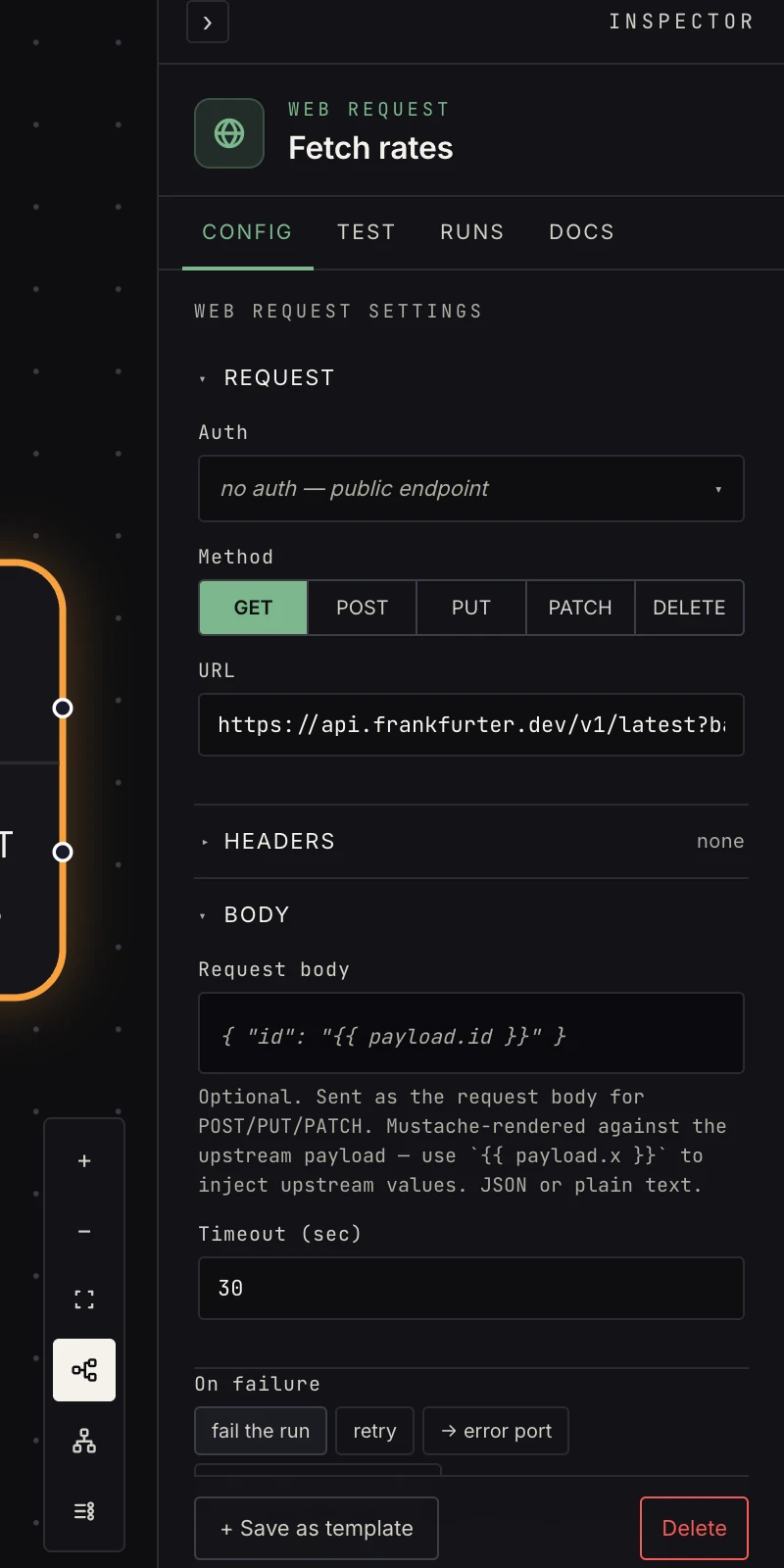 Method, URL, optional auth connection, headers, body, timeout.
- Method + URL — the URL is template-rendered:
https://api.example.com/users/{{ payload.id }}. - Auth — optional. Bind a connection and the right auth header (bearer / basic / api-key) is injected automatically; public endpoints need nothing.
- Headers / body — both template-rendered. The body is only sent for POST / PUT / PATCH; JSON or plain text.
- On failure — 2xx routes
ok; non-2xx or a transport failure fails the run by default. Setcontinueto route a{ok: false, error}payload out theerrorport instead.
Output
The next step's payload is the decoded response body — no
wrapper. A GET returning {"fact": "..."} → {{ payload.fact }}.
Two special cases:
- A bare JSON array (or scalar) response is wrapped as
{"value": [...]}— payloads are always maps. Loop overpayload["value"]. - Status and headers aren't on the payload; when you need them,
they're on the raw output by step id:
steps.<id>.output.status.
Patterns
- Fetch → understand → act — the canonical chain: web request → AI step → send.
- Scrape — GET a page → extract HTML.
- Fan out — fetch a list → loop over
payload["value"]→ fetch each detail.
Gotchas
- Never leave a templated URL segment that can render empty —
…/users/{{ payload.id }}with a missingidproduces a malformed path, and many APIs answer those with misleading 403s, not 404s. - Reference the field that holds the API's answer, not the
value you sent (an FX response's
rates.USD, not youramount).