Building workflows
The canvas, the step palette, wiring data between steps, and testing as you build.
A workflow is a graph: steps (nodes) connected by edges that carry each step's output into the next step's input.
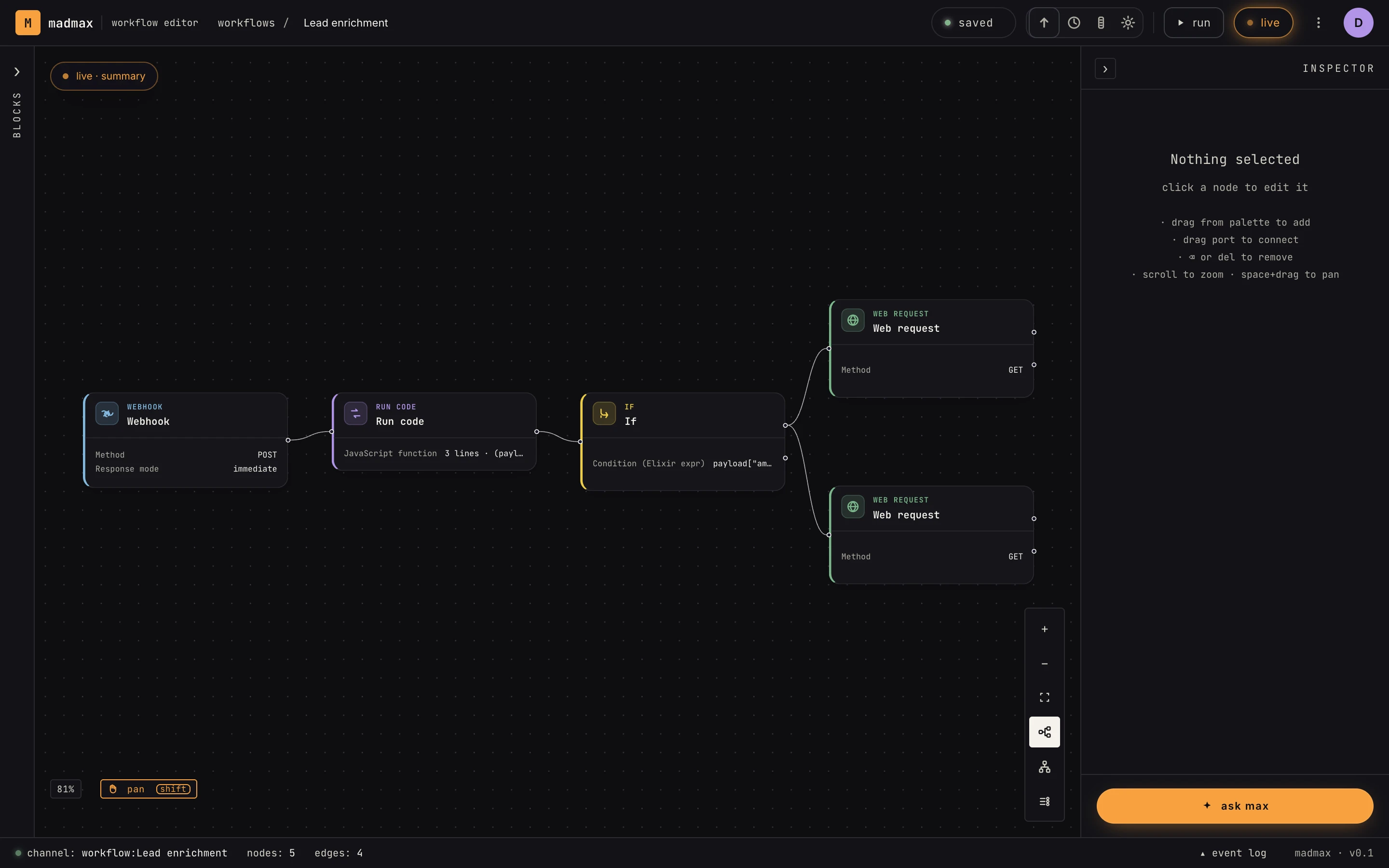 The canvas: a webhook feeding code, a branch, and two web requests. Click any card to configure it in the Inspector.
The palette
Steps are grouped into blocks by intent:
- start — triggers: webhook, schedule, manual, call from another workflow
- understand — AI steps: agents, classification, extraction
- fetch — read from the outside world: HTTP requests, integrations
- transform — reshape data: code, templates
- decide — branch, loop, delay
- check — human approval, validations
- act — write to the outside world: send the Slack message, update the sheet
Drag a step onto the canvas (or ask Max to add it), then configure it in the Inspector on the right.
Referencing data between steps
Step configs interpolate upstream outputs with {{ }} expressions —
pick fields from the reference panel in the Inspector rather than
typing paths by hand. A step's output shape is documented on its
template and visible from any real run.
Test as you go
Every step has a Verify action: MadMax runs the step against real upstream data and shows you the output before you build on top of it. For webhook-triggered workflows, use capture to grab a real payload from the source system — sample data you type in never counts as a verified test.
Integrations and connections
Steps that talk to external apps (Slack, Google Sheets, GitHub, …) need a connection — set them up in Settings → connectors (OAuth where the provider supports it). A step missing its connection shows as incomplete in the Inspector, and activation is blocked until every step is complete.