AI memory
Conversation memory for agent steps: sessions keyed by your template, a window of recent turns, a rolling summary, recall of relevant earlier turns, and full transcript view + clearing in Settings.
Give an AI agent step a memory and it remembers prior exchanges across runs — the difference between a stateless responder and something that can say "same issue as yesterday's ticket."
How it works
Create a memory in Settings → data → memory, then bind it on the agent step. Each run, the agent gets three layers of history:
- Recall — the few earlier turns most relevant to what's being asked right now, found by meaning and keywords from beyond the window (default 3, configurable; can be turned off),
- a rolling summary of everything older than the window,
- the window — the most recent turns verbatim (default 10, configurable 1–100).
It answers with all three in context, then the new exchange is appended to the memory.
Recall scope
A memory usually holds many conversations (one per session key — a caller, a chat, a thread). Same session (the default) recalls only from the conversation the run belongs to, so one customer's history never surfaces in another's. Every session recalls across the whole memory — one shared brain for an internal assistant that should remember what anyone told it, in any channel.
Sessions
The agent step's session key template decides which
conversation a run belongs to: {{ payload.chat_id }} gives every
chat its own history; {{ payload.from }} gives every sender one;
a blank key means one shared conversation.
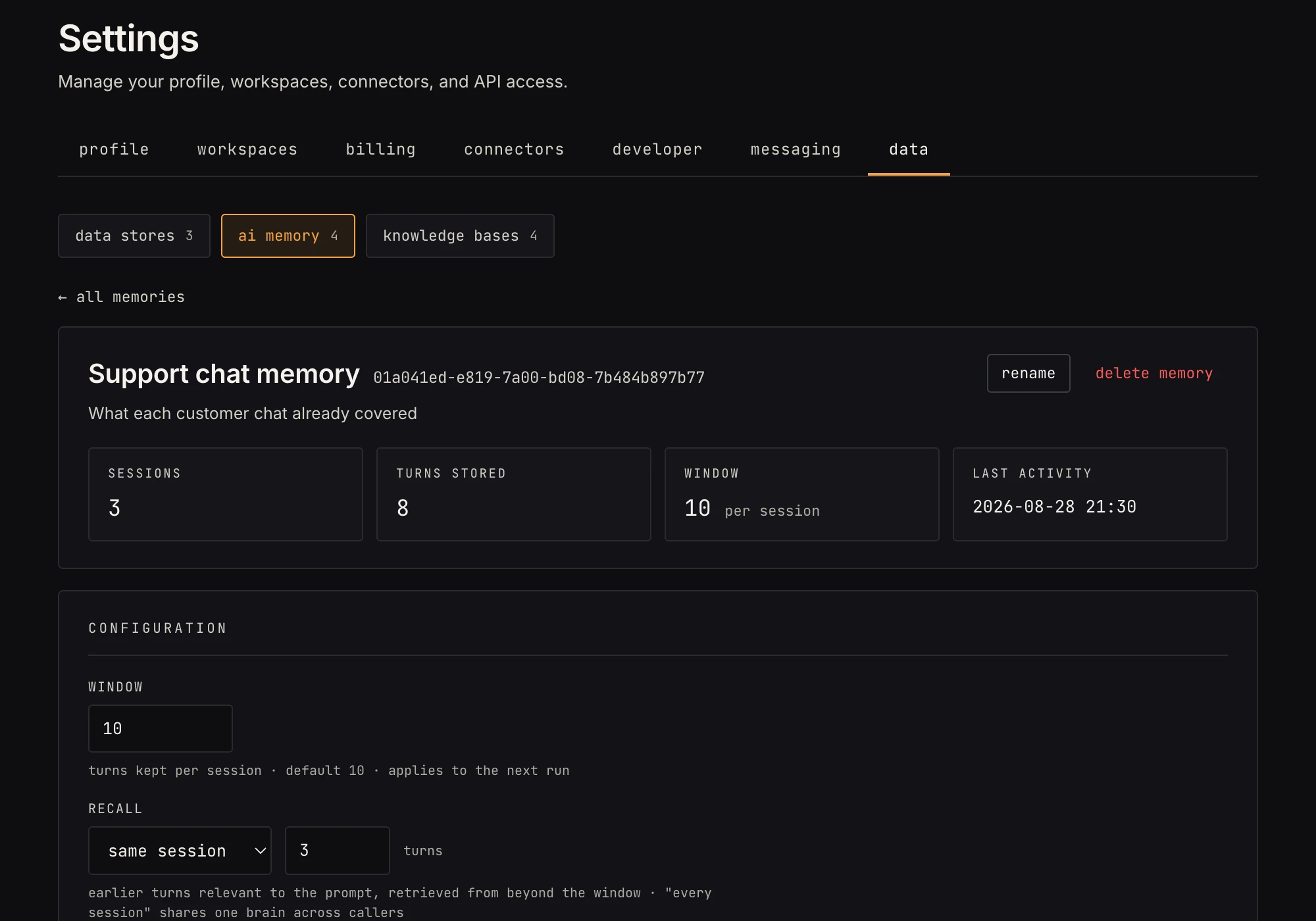 Sessions, turns stored, and the configuration card: window size and recall (scope + how many turns).
Managing it
The memory's page in Settings lists sessions newest-first; click one for the full transcript. You can clear a single session or the whole memory — the flash tells you how many turns went. The Configuration card sets the window and recall. Contents are encrypted at rest.
Gotchas
- With memory bound, the agent answers in text mode
(
payload.text) — memory and structured output don't combine on one step. - The window is what the model sees verbatim; keep it modest — every windowed turn is prompt tokens on every run. Older context reaches the model through the summary and recall instead, at a fixed cost.
- Recall matches on relevance, not time — "what did I say about the invoice?" works; "what did I say two hours ago?" doesn't.
- Memory is for conversation. For facts and records, a store is cheaper, queryable, and doesn't expire out of a window.