Knowledge bases
Upload documents, get retrieval: knowledge bases chunk and embed your files so agent steps answer grounded in them.
Upload documents; agents answer from them. A knowledge base is the "answer based on our docs" primitive — retrieval-augmented generation without any plumbing.
Uploading
Settings → data → knowledge bases — create one, then drag in
documents: .pdf, .txt, .md, .csv, .json (up to 20 MB
each, five at a time). Each document is:
- read — PDFs are transcribed with AI vision, so scanned documents work;
- chunked — split into overlapping ~800-token passages along paragraph boundaries;
- embedded — indexed for semantic search, asynchronously (chunks show a pending dot until indexed).
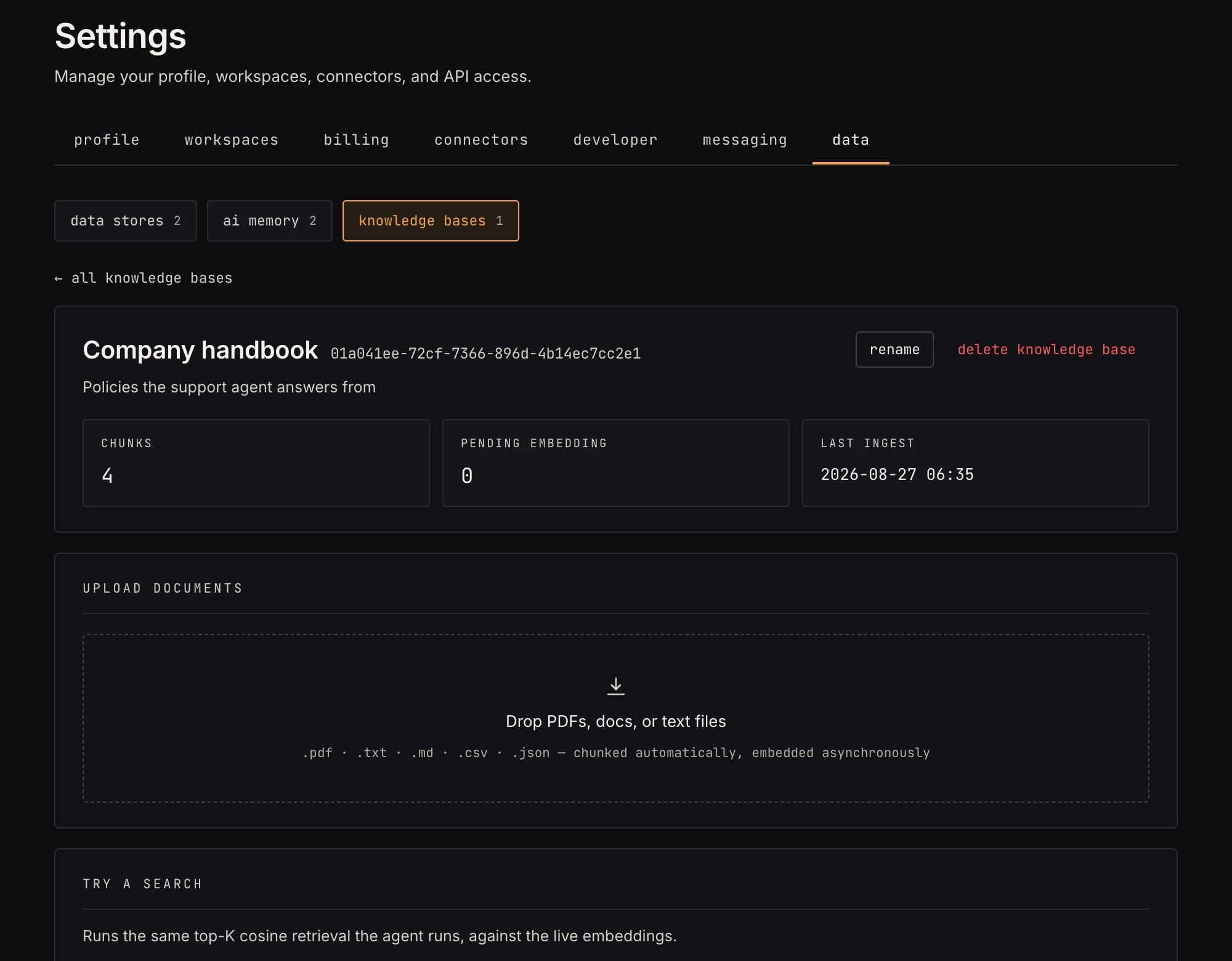 Chunk count, a retrieval test box, and the newest chunks with their source documents.
Retrieval
Bind the base on an agent step. Each run, the agent embeds its prompt, retrieves the most relevant chunks (default 5 — the Retrieved chunks slider), and answers with them as context. The agent is instructed to say so when the answer isn't in the retrieved material, rather than invent one.
The search box on the base's page runs the same retrieval the agent runs — the fastest way to check "would the agent find the refund policy?" before wiring anything.
Gotchas
- Retrieval is top-K, not whole-corpus: the agent sees the K most relevant chunks, not everything. Questions whose answer is smeared across many documents ("summarize all 40 PDFs") aren't a retrieval fit — that's a loop over documents.
- Uploads are per-base. Deleting and re-uploading a revised document is the update path.
- Structured, keyed facts (prices, fees, per-county values) belong in a store — exact lookups beat semantic search for exact data.