Build by hand
Build your first workflow without the AI: drag blocks, connect edges, configure steps in the Inspector, test each one, and activate.
The AI can build whole workflows from a sentence, but everything it does is ordinary canvas work you can do yourself. Building one small workflow by hand teaches you the grammar. We'll make: a webhook that receives an order and posts big ones to Slack.
1. Drag a trigger
Open Blocks in the left panel and drag Webhook (under START) onto the canvas. Every workflow begins with exactly one trigger-ish entry — the palette's START group.
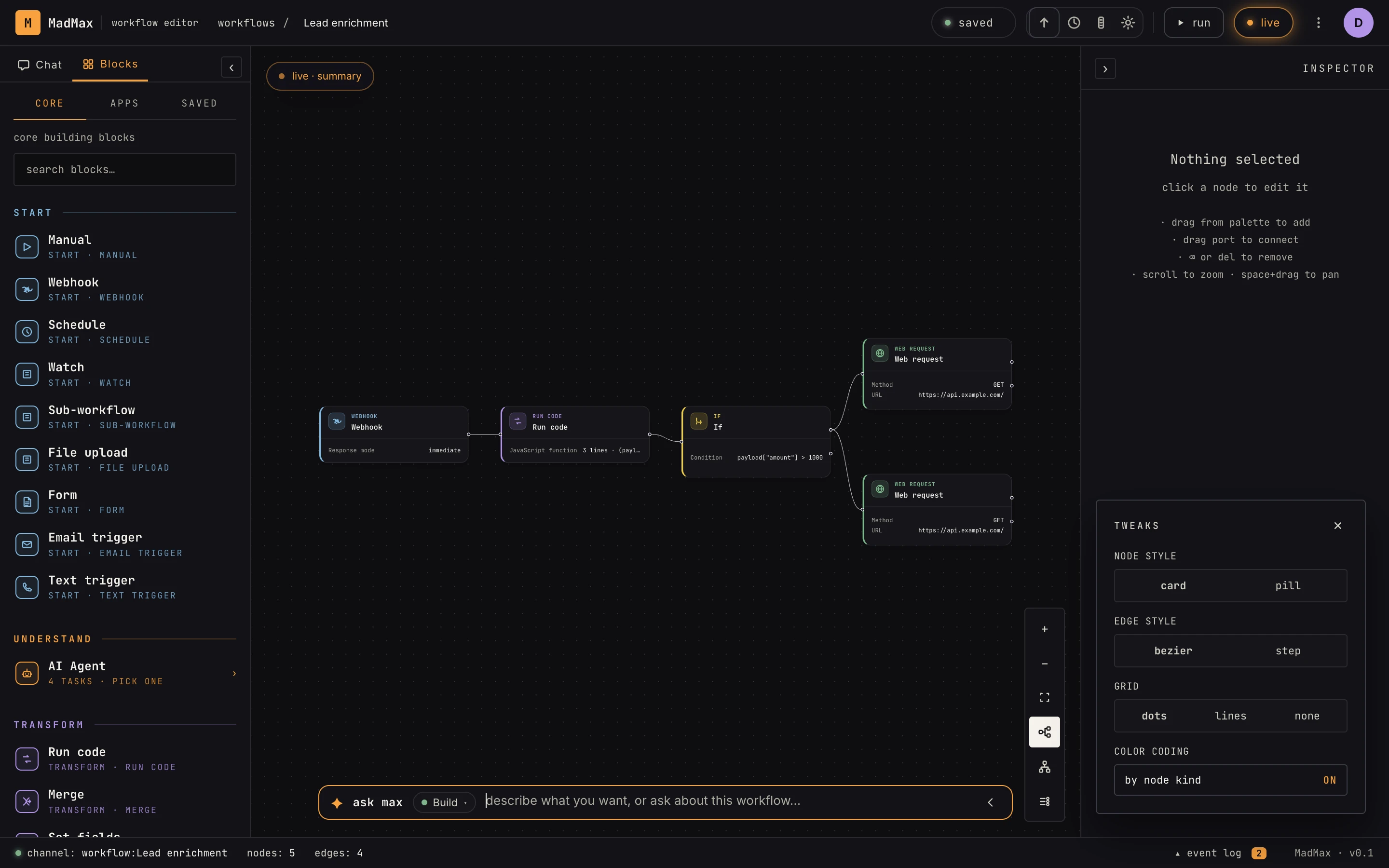 Blocks drag straight from the palette. The card shows the step's key config at a glance.
2. Add and connect steps
Drag an If (DECIDE) and a Slack app step (or Send email if you haven't connected Slack) to the right of it. Connect them: click-drag from the small circle on a node's output edge to the next node's input. If has two outputs — true and false — wire both; an unwired branch silently drops whatever flows into it.
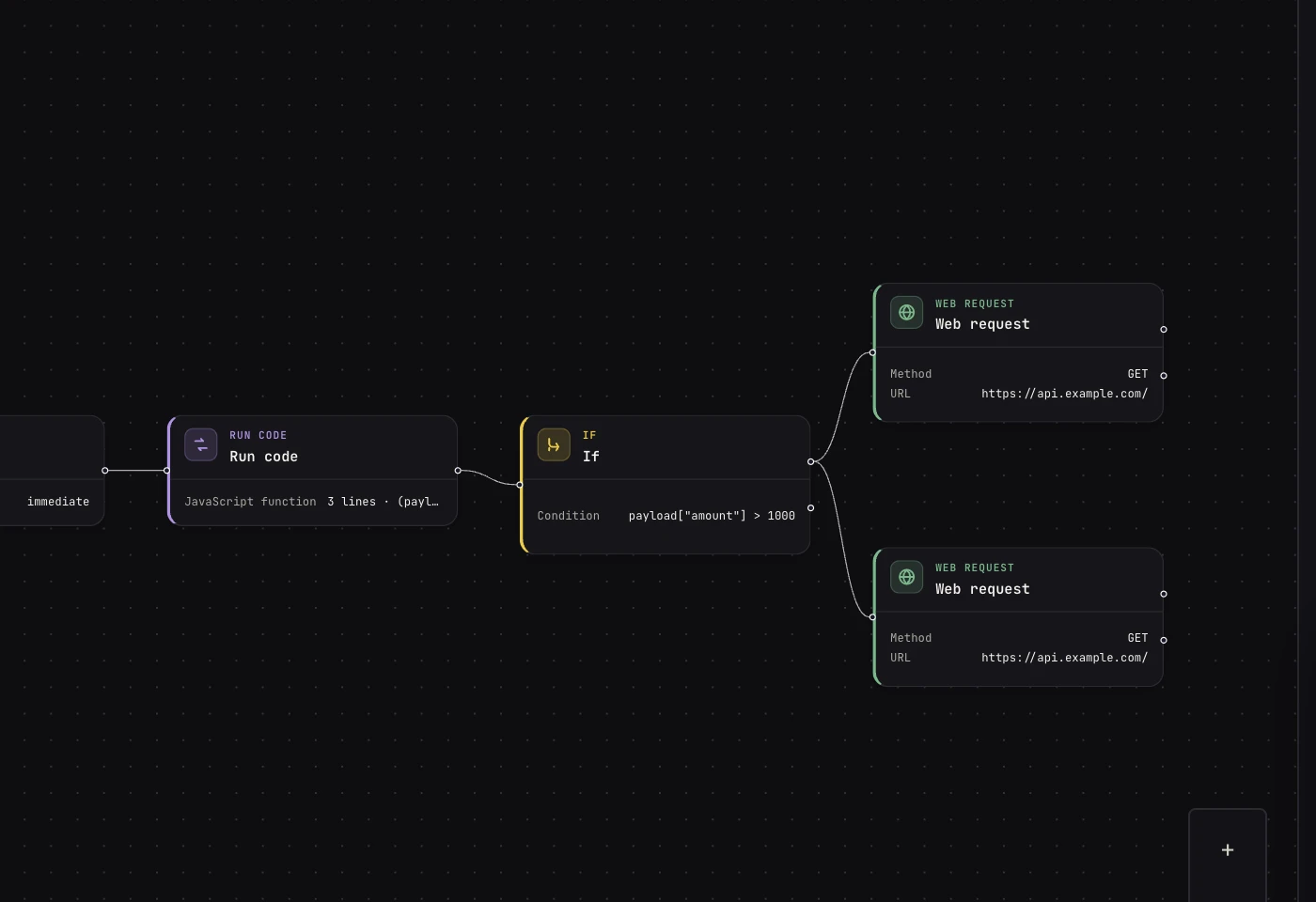 Ports are the small circles. Multi-output steps (if, switch, loop) label each port.
3. Configure in the Inspector
Click the If node. The Inspector opens on the right with the step's fields — for If, a single expression:
payload["body"]["amount"] > 1000
Two things to notice: the webhook's output nests the caller's JSON
under body (see core concepts), and logic
expressions use bracket syntax, not {{ }} templates.
4. Test before you trust
Open the Inspector's Test tab and hit Run now on the webhook — MadMax gives you the trigger URL and holds a sample window so you can send a real request (curl works fine). Each step you test pins its latest output, and downstream steps test against those pinned outputs — so you can prove the chain step by step with real data before anything goes live.
5. Activate
Hit Activate in the topbar. The canvas freezes into a snapshot, the webhook URL goes live, and the run appears in run history every time it fires. Keep editing freely — the live snapshot doesn't change until you activate again.
Where to go next
- The canvas tour — every panel, button, and shortcut.
- AI workflow automation — the same build, from one sentence.