AI Agent
The AI Agent step: one tile, four tasks — extract structured data, classify, summarize, or run a custom prompt — on the MadMax default model or your own key.
The AI step. One tile in the palette's Understand block, four tasks — pick the one that names what you want:
| task | what it does | output lands at |
|---|---|---|
| Custom prompt | your own instruction, optional structured output, tools, memory, knowledge | payload.data.* or payload.text |
| Extract | pull declared fields out of text or an uploaded document (AI vision) | payload.fields.* |
| Classify | sort the input into labels you define | payload.data.label |
| Summarize | condense the input to the essentials | payload.text |
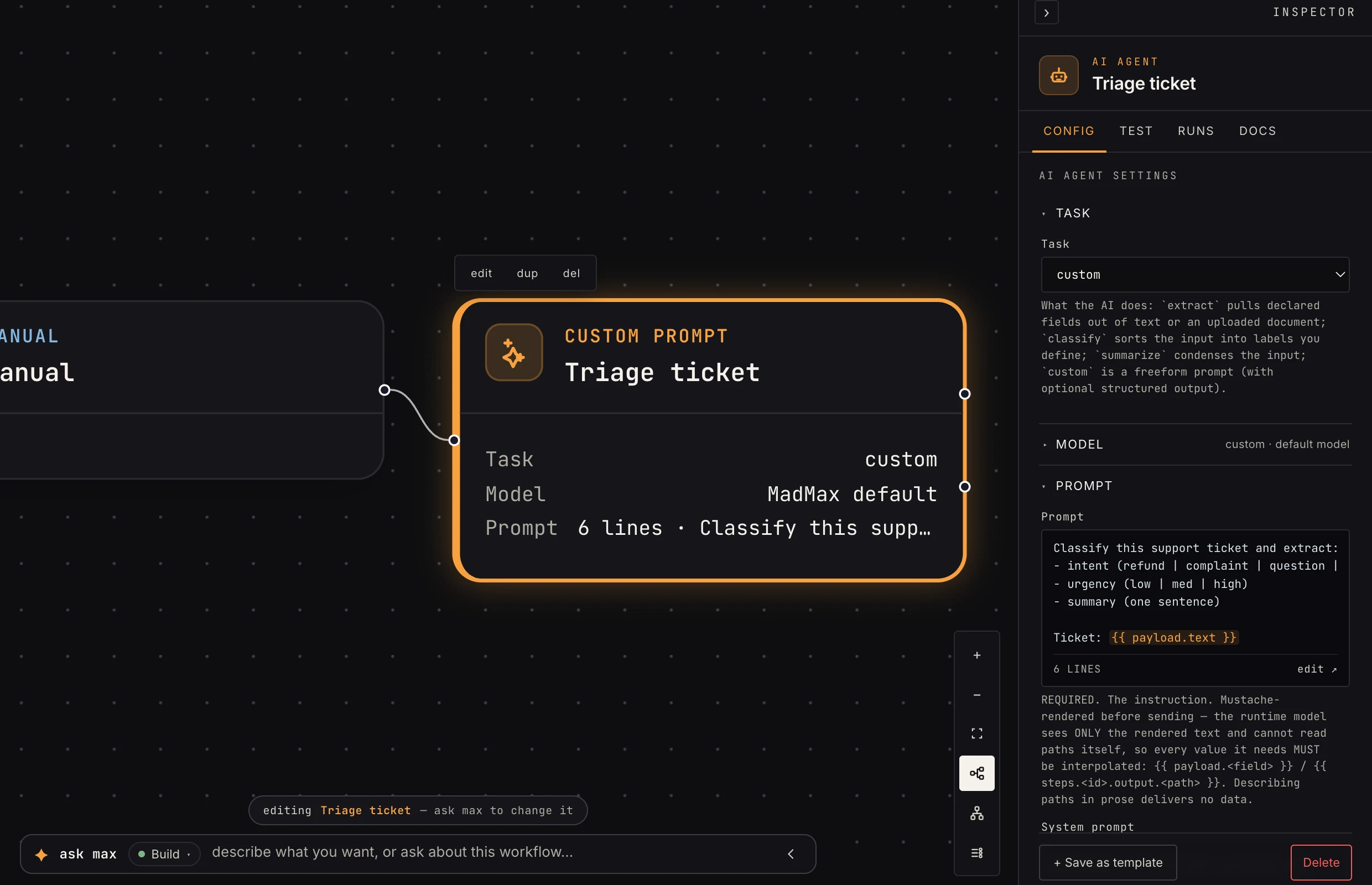 The task picker decides which fields the Inspector shows.
The model
By default the step runs on MadMax default — the platform model, billed to your workspace in credits, no API key needed. That's the right choice almost always.
To use your own provider instead (bring-your-own-key), connect an AI provider in settings → connections and pick it in the Provider field — a Model picker then appears for that provider's models. Usage bills to your key, not your credits.
Temperature (advanced) applies either way: 0 is deterministic
(right for extraction and classification), higher is more creative.
Routing
The step has two output ports: ok and error. Success routes
ok. By default an API failure or schema violation fails the
step and the run — set On failure to continue to route a
{ok: false, error: …} payload out the error port so the
workflow survives (pair it with a branch or a
notification on that port).
Which task?
- A later step references specific fields the AI produces → Custom prompt with an output schema, or Extract when the fields come from a document.
- Routing decisions ("is this a refund request?") → Classify, then branch on the label.
- Human-readable digest at the end of a chain → Summarize.
- Tools, memory, or knowledge-base retrieval → Custom prompt — the other tasks are deliberately simpler.